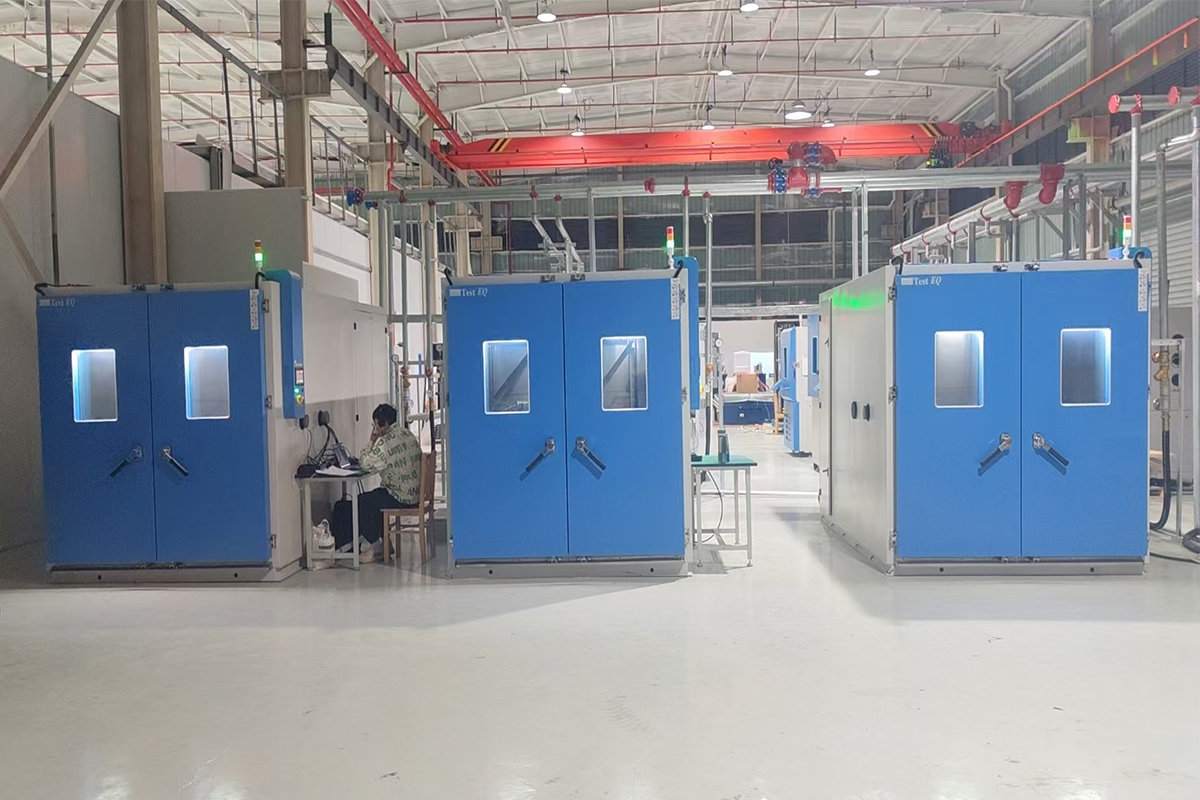
Why Temperature Ramp Stability Matters
Temperature ramp instability may cause:
Non-uniform temperature distribution
Test repeatability problems
Inconsistent thermal stress
Extended testing time
Failure to meet IEC, JEDEC or MIL-STD requirements
Increased energy consumption
For applications such as thermal cycling, ESS testing and reliability qualification, stable ramp control is often more important than maximum ramp speed.
1. Airflow Design Problems
Air circulation is one of the biggest factors affecting ramp stability.
Poor airflow design can result in:
Temperature overshoot
Hot and cold spots
Slow response time
Uneven chamber temperature distribution
Traditional chambers often experience airflow turbulence during rapid transitions, causing fluctuations and instability.
High-performance environmental chambers use optimized duct structures and balanced airflow systems to maintain temperature uniformity during fast ramps.
2. Refrigeration System Limitations
The refrigeration system determines how effectively the chamber removes heat.
Common issues include:
Insufficient cooling capacity
Compressor mismatch
Slow refrigerant response
Heat exchange inefficiency
During high-speed temperature changes, inadequate refrigeration systems may produce:
Temperature lag
Excessive overshoot
Ramp interruptions
Unstable cooling curves
This problem becomes especially noticeable in chambers operating at:
10°C/min
15°C/min
20°C/min
25°C/min or above
3. PID Control Tuning Errors
PID algorithms regulate heating and cooling outputs.
Improper tuning may cause:
Overshoot
Temperature exceeds the setpoint and oscillates repeatedly.
Hunting
Continuous fluctuations around the target temperature.
Slow Recovery
Delayed stabilization after load changes.
Advanced controllers with adaptive PID algorithms provide much smoother temperature transitions and better repeatability.
4. Test Load Influence
Many manufacturers specify ramp rates under no-load conditions.
However, actual loads can significantly affect chamber performance.
Factors include:
Product weight
Material thermal mass
Fixture design
Sample arrangement
Airflow blockage
Heavy battery packs or semiconductor fixtures absorb heat and slow the temperature response.
Therefore, loaded ramp rate performance is often more meaningful than empty chamber specifications.
5. Sensor Position and Calibration
Temperature sensors play a crucial role in feedback control.
Incorrect sensor placement can cause:
Measurement delays
False temperature readings
Oscillation
Control instability
Regular calibration helps ensure accurate temperature monitoring and repeatable test results.
6. Chamber Structure and Insulation
Poor insulation allows external heat leakage and creates unnecessary thermal disturbances.
Structural problems may include:
Door leakage
Inadequate insulation materials
Thermal bridges
Excessive heat loss
These issues become increasingly critical in chambers operating from -70°C to +180°C.
How TestEQ Improves Ramp Stability
As an environmental chamber manufacturer, TestEQ focuses not only on ramp speed but also on linear ramp accuracy and temperature consistency.
Key features include:
Cold-Hot Balance Technology
Optimizes heating and cooling output to minimize overshoot and maintain stable transitions.
Intelligent PID Control
Adaptive algorithms automatically adjust system response to varying loads.
Optimized Airflow Design
Uniform circulation improves temperature distribution throughout the workspace.
High-Efficiency Refrigeration System
Supports stable ramp rates from 5°C/min to 30°C/min.
Real Load Performance
Chambers are engineered to maintain reliable ramp characteristics under practical testing conditions.
These capabilities make TestEQ systems suitable for:
Semiconductor reliability testing
Aerospace qualification
ESS screening
Automotive component validation
Selecting a Stable Rapid Temperature Change Chamber
When evaluating suppliers, engineers and procurement teams should look beyond maximum ramp rate specifications.
Consider:
Loaded ramp rate performance
Temperature uniformity
PID control capability
Airflow design
Compressor configuration
Compliance with IEC and JEDEC standards
Long-term repeatability
A well-designed chamber delivers stable temperature transitions, improved test accuracy and lower operating costs over its service life.
Conclusion
Temperature ramp instability is typically caused by airflow imbalance, refrigeration limitations, poor PID tuning, heavy test loads, sensor errors and inadequate chamber construction.
Selecting a chamber with advanced control technology and optimized thermal design is essential for achieving reliable and repeatable environmental testing.
TestEQ provides rapid temperature change chambers with stable 5–30°C/min linear ramp performance, helping laboratories and manufacturers improve testing efficiency and product reliability.
Internal Linking Module
Recommended Products
Designed for semiconductor, EV battery and aerospace testing, TestEQ rapid temperature change chambers provide stable 5–30°C/min linear ramp rates with optimized airflow and intelligent PID control.
TestEQ environmental test chambers deliver precise temperature and humidity control for reliability testing, quality assurance and product validation applications.
Related Standards
Understand JEDEC temperature cycling requirements and reliability qualification procedures for semiconductor devices.
Learn about IEC 60068 environmental testing methods, temperature cycling requirements and chamber performance criteria.
Related Resources
Discover how temperature cycling, thermal shock and accelerated environmental testing help semiconductor manufacturers identify latent defects and reduce product failure rates.
Compare thermal cycling and thermal shock testing methods and select the appropriate reliability test for your application.
FAQ
Why does my environmental chamber overshoot during temperature changes?
Overshoot is usually caused by improper PID settings, airflow imbalance or insufficient refrigeration capacity.
Does load affect temperature ramp rate?
Yes. Heavy samples and fixtures absorb heat and reduce actual ramp performance. Loaded ramp rates are more representative than empty chamber specifications.
Is higher ramp speed always better?
Not necessarily. Stability and repeatability are often more important than peak ramp speed for reliability testing.
What industries require stable temperature ramp control?
Semiconductor, aerospace, EV battery, automotive and electronics industries all rely on stable temperature transitions for qualification testing.
CTA
Need a Stable 5–30°C/min Temperature Ramp Solution?
TestEQ designs high-performance rapid temperature change chambers for semiconductor, EV battery, aerospace and automotive applications.
"Contact our engineering team today" to discuss your testing requirements and receive a customized chamber solution.