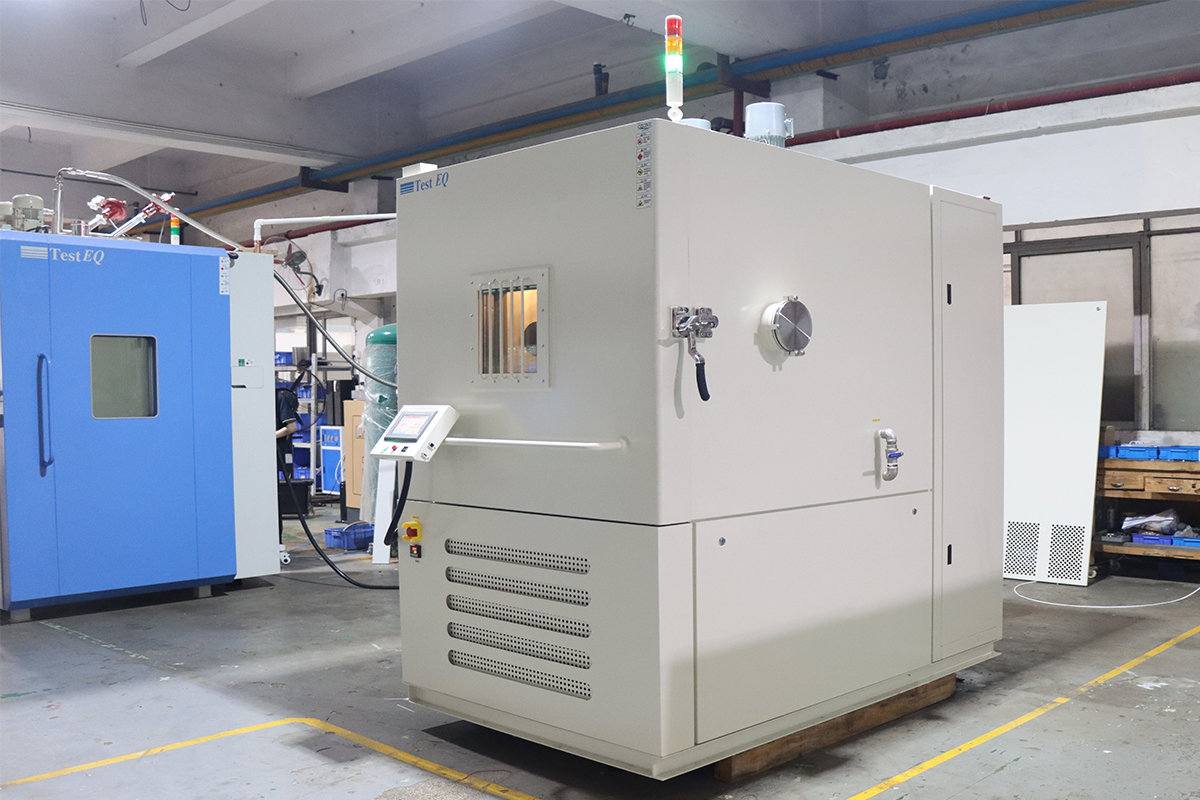
What Is HALT Testing?
HALT (Highly Accelerated Life Testing) is a product development and design validation method that pushes products beyond their intended operating limits.
During HALT, samples are exposed to:
Rapid temperature changes
Extreme hot and cold temperatures
Multi-axis vibration
Combined environmental stresses
The goal is not pass/fail certification. Instead, HALT is used to:
Discover hidden design weaknesses
Identify failure mechanisms
Improve product robustness
Accelerate design optimization
HALT is typically performed during the R&D and prototype stage before mass production.
Typical HALT Applications
Automotive electronics
Industrial controllers
Power electronics
Aerospace systems
Telecommunications equipment
Medical devices
What Is Thermal Cycling Testing?
Thermal Cycling Testing repeatedly exposes a product to alternating high and low temperatures according to predefined test standards.
Unlike HALT, thermal cycling focuses on simulating real-world temperature expansion and contraction over time.
The objective is to evaluate:
Solder joint fatigue
Material degradation
PCB reliability
Connector durability
Long-term field performance
Thermal cycling is commonly used for qualification, compliance testing, and reliability verification.
Common Standards
JESD22-A104
AEC-Q100
IEC 60068-2-14
MIL-STD-883
IEC 60749
HALT vs Thermal Cycling: Key Differences
| Item | HALT | Thermal Cycling |
|---|---|---|
| Purpose | Find design limits | Verify reliability |
| Test Stage | R&D / Prototype | Qualification / Production |
| Temperature Range | Beyond specifications | Within defined specifications |
| Vibration | Included | Usually not included |
| Pass/Fail Criteria | No | Yes |
| Test Duration | Shorter | Longer |
| Main Goal | Discover weaknesses | Validate durability |
The most important distinction is that HALT seeks failure, while Thermal Cycling evaluates whether a product can survive expected environmental conditions.
When Should You Use HALT?
HALT is recommended when:
Developing a new product platform
Reducing field failure risk
Improving product robustness
Identifying weak design margins
Accelerating product development cycles
Engineering teams often use HALT to uncover problems that may not appear during conventional qualification testing.
When Should You Use Thermal Cycling?
Thermal Cycling is preferred when:
Meeting customer specifications
Demonstrating compliance with industry standards
Supporting PPAP qualification
Verifying solder joint reliability
Performing production reliability validation
For automotive and semiconductor suppliers, thermal cycling remains one of the most important qualification methods.
Why Many Manufacturers Use Both
Leading manufacturers frequently combine HALT and Thermal Cycling testing.
A typical workflow is:
Use HALT during product development to identify design weaknesses.
Improve design margins.
Perform Thermal Cycling according to industry standards.
Validate long-term reliability before production release.
This approach helps reduce warranty costs while improving product quality and customer confidence.
TestEQ Solutions for Reliability Testing
TestEQ provides advanced environmental testing solutions for reliability laboratories, electronics manufacturers, automotive suppliers, and research organizations.
Key capabilities include:
Rapid-rate temperature cycling chambers
Thermal shock systems
Automated data acquisition and monitoring
OEM and non-standard chamber customization
Our systems support reliability validation programs ranging from prototype development to production qualification testing.
Conclusion
HALT and Thermal Cycling are not competing test methods—they are complementary reliability tools.
If the objective is to discover design weaknesses and improve robustness, HALT provides faster insight. If the goal is qualification, compliance, and durability verification, Thermal Cycling remains the industry standard.
Organizations that integrate both methods into their reliability strategy often achieve faster product development, lower failure rates, and improved customer satisfaction.
Recommended Internal Links
Related Test Standards
Learn the most widely used thermal cycling and thermal shock standards for electronics, automotive, and semiconductor qualification.
Related Resources
Explore expert resources covering accelerated reliability testing methods, qualification standards, and failure analysis techniques.
Recommended Equipment
High-performance environmental test chambers designed for accelerated reliability testing, qualification, and product validation.
FAQ
Is HALT a replacement for Thermal Cycling Testing?
No. HALT identifies design weaknesses, while Thermal Cycling validates reliability against specified requirements. Most manufacturers use both methods during product development and qualification.
Which industries commonly use HALT testing?
HALT is widely used in automotive electronics, aerospace, telecommunications, industrial automation, medical devices, and defense applications.
What standards are used for Thermal Cycling Testing?
Common standards include JESD22-A104, AEC-Q100, IEC 60068-2-14, MIL-STD-883, and IEC 60749.
Can one chamber perform both HALT and Thermal Cycling tests?
In some cases, customized environmental test systems can support both testing approaches. However, HALT often requires additional high-rate temperature change and vibration capabilities.
Why is Thermal Cycling important for electronics?
Thermal Cycling helps identify failures caused by repeated expansion and contraction of materials, including solder joint cracking, PCB fatigue, and connector degradation.
CTA
Need a Reliability Testing Solution for HALT or Thermal Cycling?
TestEQ engineers provide customized environmental test chambers for electronics, automotive, aerospace, and industrial reliability programs.
Fast temperature ramp rates up to 25°C/min
Custom chamber configurations
Compliance with JESD, IEC, MIL-STD and AEC standards
Global technical support
"Contact TestEQ today" to discuss your HALT, HASS, Thermal Cycling, or Thermal Shock testing requirements.