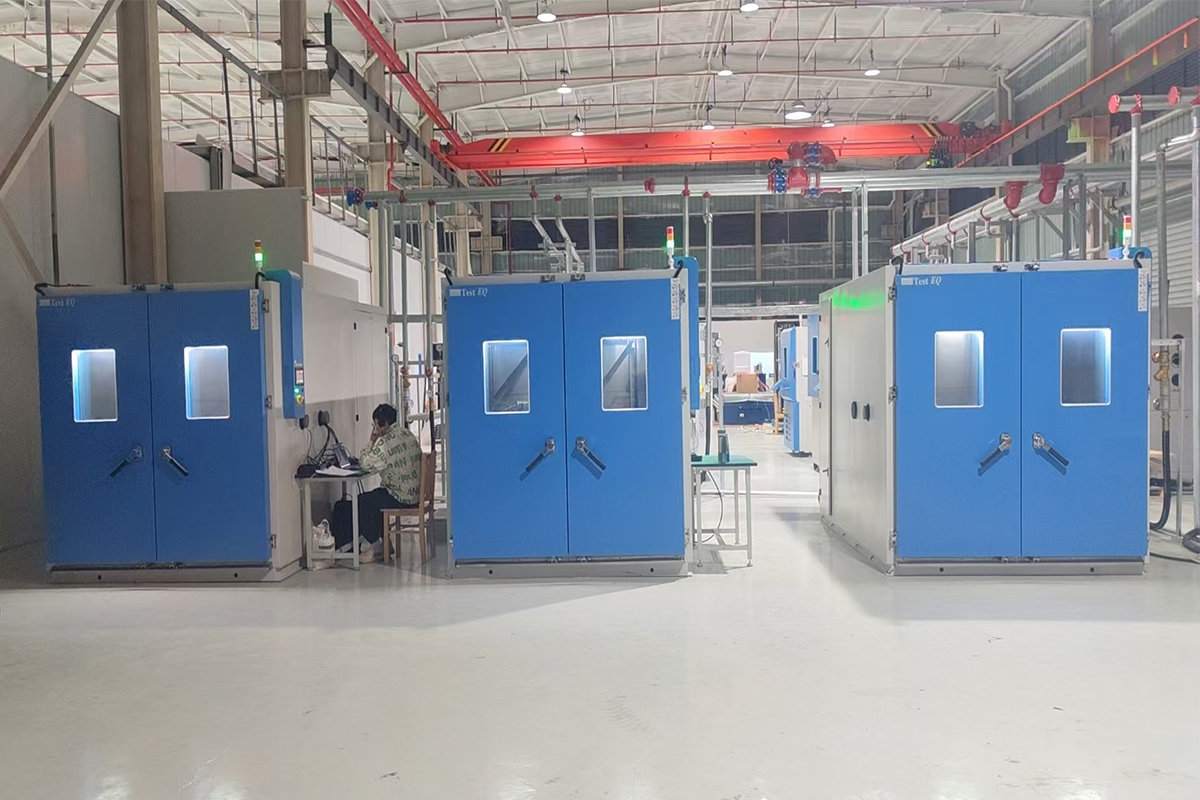
What Is a Temperature Humidity Vibration Test Chamber?
A Temperature Humidity Vibration Test Chamber (THV Chamber) is a multi-stress environmental simulation system that integrates:
Temperature cycling (heat & cold)
Humidity conditioning (moisture & condensation)
Mechanical vibration (random or sinusoidal motion)
into a single controlled test environment.
It is designed to reproduce real-world operating conditions where products are exposed to simultaneous thermal, moisture, and mechanical stress.
Compared to traditional single-factor chambers, a THV system significantly improves failure detection efficiency and test realism, making it a critical tool for reliability engineering.
How a THV Chamber Works
A THV chamber integrates three subsystems working in synchronized control:
1. Temperature Control System
Uses refrigeration compressors and heating elements to simulate extreme conditions from typically -70°C to +180°C.
2. Humidity Control System
Maintains controlled relative humidity (20%–98% RH) to simulate condensation, corrosion, and insulation aging.
3. Vibration System
An electrodynamic or hydraulic shaker applies controlled vibration profiles:
Sine wave vibration
Random vibration
Shock simulation
These systems operate independently or in synchronized test programs depending on the test standard.
Why Combined Testing Is Critical
Real-world environments are never single-stress conditions.
For example:
EV batteries face heat + vibration + humidity during operation
Aerospace electronics experience altitude + thermal cycling + vibration
Automotive ECUs face engine vibration + thermal shock + moisture exposure
A THV chamber reproduces these multi-factor coupling effects, which cannot be achieved using separate test systems.
This is why leading OEMs are shifting from single chambers to integrated THV systems.
Applications of THV Chambers
Automotive Industry
EV battery pack validation
ECU durability testing
ADAS sensor reliability
Powertrain electronic stress screening
Avionics qualification testing
Satellite component reliability
Military electronics environmental validation
Electronics & Semiconductor
PCB fatigue testing
IC packaging reliability
Consumer electronics durability testing
Energy Storage Systems
Lithium battery cycling under vibration
Thermal runaway simulation
Safety certification testing
Benefits of THV Testing
✔ Faster Failure Detection
Combines multiple stress factors to accelerate degradation mechanisms.
✔ Reduced Test Time
Eliminates need for separate environmental and vibration tests.
✔ Higher Design Confidence
Reveals hidden design weaknesses before mass production.
✔ Compliance Ready
Supports standards such as:
IEC testing standards
ISO environmental reliability standards
MIL-STD vibration requirements
Automotive OEM validation protocols
✔ Lower Total Testing Cost
One integrated system replaces multiple standalone machines.
Types of THV Test Chambers
Compact THV Chambers
For R&D labs and component-level testing.
Standard THV Systems
For subsystem validation in automotive and electronics.
Walk-in THV Chambers
For full-scale products such as EV batteries or aerospace assemblies.
Custom Engineering Systems
Designed for aerospace, defense, and advanced R&D applications.
Why TestEQ THV Systems
TestEQ designs engineering-grade environmental test systems for industrial reliability validation.
Our THV chambers focus on:
High precision multi-stress control
Long-duration stability testing
Modular vibration integration design
Global compliance capability
Custom engineering for OEM requirements
We support engineering teams from R&D validation → qualification testing → production reliability screening.
Internal Linking Module
Recommended Equipment
A climate simulation chamber designed for temperature and humidity cycling tests. Suitable for electronics, automotive components, materials and long-term reliability evaluation.
An integrated environmental test system combining temperature, humidity and vibration stresses for aerospace, military and electronic reliability testing.
Related Standards
Understand the major international standards related to temperature, humidity and vibration combined testing, including IEC 60068 and other reliability test requirements used in aerospace, automotive and electronics industries.
An international standard series covering cold, dry heat, humidity and combined environmental tests for electronic and industrial products.
Related Resources
Learn how Highly Accelerated Stress Testing (HAST) is used to evaluate moisture resistance and package reliability in semiconductor and electronic devices.
A complete guide explaining the working principles, applications and key specifications of temperature and humidity chambers used in environmental reliability testing.
FAQ
What is a Temperature Humidity Vibration Test Chamber used for?
It is used to simulate real-world environmental conditions combining temperature, humidity, and vibration for reliability testing of products.
Why is combined testing better than separate tests?
Because real-world conditions involve multiple stresses simultaneously, combined testing reveals failures that single-factor tests cannot detect.
Which industries use THV chambers?
Automotive, aerospace, electronics, semiconductor, and energy storage industries widely use THV chambers.
What standards does a THV chamber support?
It supports IEC, ISO, MIL-STD, and OEM-specific environmental testing standards.
Can vibration and climate tests run simultaneously?
Yes, advanced THV systems are designed to run vibration, temperature, and humidity simultaneously or in programmable sequences.
CTA:
Need Help Selecting a Temperature Humidity Vibration Test Chamber?
Whether you need a standard AGREE chamber or a customized three-combination testing system, TestEQ engineers can help you determine the right temperature range, humidity control and vibration integration solution for your application.
Contact us today for technical support, chamber specifications and a free quotation.
"Talk to a TestEQ Engineer and Get a Tailored THV Chamber Configuration Within 24 Hours"